
How Can Canadian Employers Hire Foreign Workers in 2026?
Introduction
Canadian employers who cannot find suitable workers in Canada may be able to hire foreign workers through Canada’s temporary foreign worker programs. However, the process depends on the position, the worker’s circumstances, the employer’s location and whether the job requires a Labor Market Impact Assessment (LMIA).
In 2026, there are two main pathways employers should consider:
- The Temporary Foreign Worker Program (TFWP), generally used when an LMIA is required.
- The International Mobility Program (IMP), which allows employers to hire certain foreign workers without an LMIA when the worker meets an applicable exemption.
Before beginning the hiring process, an employer should determine whether an LMIA is required and which program applies to the position. The Government of Canada’s requirements can change depending on the occupation, wage, province or territory and other circumstances.
Can Canadian Employers Hire Foreign Workers in 2026?
Yes. Canadian employers may hire foreign workers in 2026 when they meet the requirements of the applicable federal program and the foreign worker is eligible for a work permit.
The two main pathways are:
Pathway | LMIA required? | General purpose |
Temporary Foreign Worker Program | Usually yes | Hiring when qualified Canadians or permanent residents are not available |
International Mobility Program | No, where an exemption applies | Hiring workers whose circumstances provide an LMIA exemption |
Under the TFWP, an LMIA assesses whether hiring a temporary foreign worker is likely to have a positive or negative effect on Canada’s labor market. Under the IMP, eligible employers can hire certain workers without an LMIA because the work provides broader economic, cultural or other benefits to Canada, or because reciprocal arrangements or other public policy considerations apply.
Does My Canadian Business Need an LMIA to Hire a Foreign Worker?
Not necessarily. The first step is to determine whether the position requires an LMIA or qualifies for an LMIA exemption.
An LMIA is generally required when an employer wants to hire a temporary foreign worker through the Temporary Foreign Worker Program. The employer must demonstrate that the job offer and business are legitimate and meet the applicable program requirements.
An LMIA may not be required when the worker qualifies under an International Mobility Program category or another LMIA exemption.
For example, some LMIA-exempt situations include:
- certain French-speaking or bilingual workers outside Quebec;
- some workers under international agreements or free trade agreements;
- certain International Experience Canada participants;
- some workers eligible under the Global Skills Strategy;
- certain workers with open work permits; and
- other categories established under Canada’s immigration rules.
The specific exemption must apply to the worker and position. Employers should not assume that a foreign worker is LMIA-exempt simply because they have previously worked in Canada.
How do I know if I need an LMIA?
Employers should review the Government of Canada’s “Hire a temporary foreign worker” resource and determine whether the position falls under the TFWP or an LMIA-exempt category.
If an LMIA is required, the employer generally applies through LMIA Online. A Job Bank account is required to use the LMIA Online system.
LMIA vs International Mobility Program: What’s the Difference?
The key difference is whether the employer needs to demonstrate through an LMIA that hiring the foreign worker is justified based on Canada’s labor market requirements.
Temporary Foreign Worker Program
The Temporary Foreign Worker Program is generally used when employers need an LMIA before hiring a temporary foreign worker.
Depending on the position, an employer may need to apply under a specific stream, including:
- high-wage positions;
- low-wage positions;
- primary agriculture;
- Global Talent Stream;
- caregivers;
- positions supporting permanent residence; or
- other applicable streams.
The requirements vary by stream. For example, employers hiring for high-wage positions generally need to conduct recruitment activities and demonstrate efforts to hire Canadians and permanent residents.
International Mobility Program
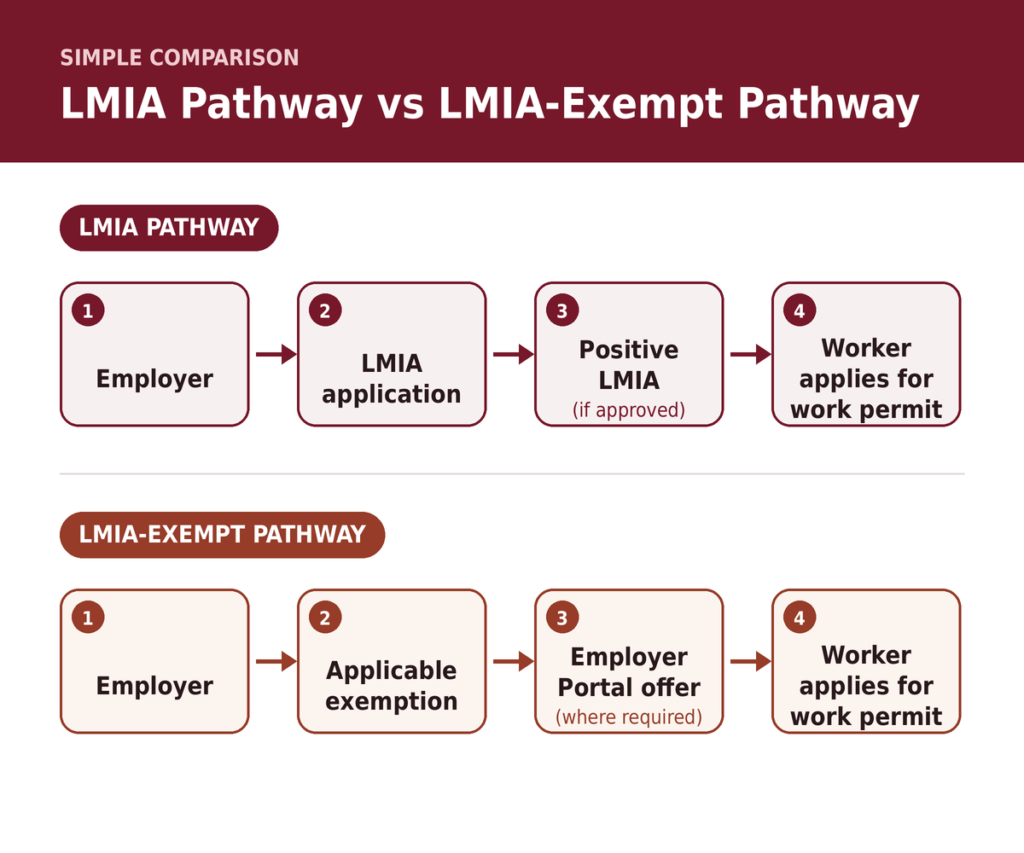
The International Mobility Program allows Canadian employers to hire certain temporary foreign workers without an LMIA when an applicable exemption exists.
In most cases, employers hiring through the IMP must submit an offer of employment through the Employer Portal and pay the $230 employer compliance fee, unless an exemption applies.
Can Canadian Employers Hire Foreign Workers Without an LMIA?
Yes, in certain circumstances.
The International Mobility Program contains several LMIA-exempt categories. For example, certain French-speaking workers outside Quebec may qualify under Mobilité francophone.
For an eligible French-speaking or bilingual worker outside Quebec, the employer can submit an offer of employment through the Employer Portal using the applicable LMIA exemption code and, in most cases, pay the employer compliance fee.
Other LMIA-exempt situations can involve:
international agreements;
significant benefit to Canada;
reciprocal employment;
charitable or religious work;
International Experience Canada;
certain intra-company or specialized situations; and
other specific exemptions.
Employers should identify the exact LMIA exemption before submitting an offer. An exemption category generally has its own eligibility requirements and documentation.
How to Hire a Foreign Worker in Canada in 2026: Step-by-Step
Step 1: Identify the position
Start by clearly defining:
- job title;
- job duties;
- work location;
- wage;
- hours of work;
- employment duration;
- required education;
- required experience; and
- applicable National Occupational Classification (NOC).
The job duties and requirements should accurately reflect the actual position.
Step 2: Determine whether an LMIA is required
Next, determine whether the worker and position qualify for an LMIA exemption.
If no exemption applies, the employer will generally need to consider the Temporary Foreign Worker Program and the appropriate LMIA stream.
If an exemption applies, the employer may be able to proceed through the International Mobility Program or another applicable LMIA-exempt category.
Step 3: Check the wage requirements
For LMIA applications, the offered wage is an important part of determining the applicable stream.
As of July 17, 2026, Canada’s hourly wage thresholds for determining high-wage versus low-wage LMIA streams vary by province or territory.
For example, the 2026 thresholds include:
- Ontario: $36.92 per hour
- British Columbia: $38.40 per hour
- Alberta: $37.50 per hour
- Manitoba: $31.33 per hour
- Saskatchewan: $34.62 per hour
- Quebec: $36.00 per hour
The complete table should be checked before submitting an application because the threshold depends on the province or territory where the worker will be employed.
The threshold is not the same as the required prevailing wage. Employers must also consider the prevailing wage for the occupation and work location.
Step 4: Check recruitment requirements
Employers applying through the TFWP generally need to demonstrate reasonable efforts to recruit Canadians and permanent residents before hiring a temporary foreign worker.
For high-wage positions, employers generally need to conduct at least three different recruitment activities, including advertising on the Government of Canada’s Job Bank, unless an applicable variation or exception applies.
Low-wage positions also have specific recruitment requirements, including Job Bank advertising and additional recruitment activities.
Recruitment requirements can vary by stream and occupation, so employers should check the applicable requirements before advertising the position.
Step 5: Check whether the position can be processed
Employers should check whether any refusal-to-process measures apply before submitting an LMIA.
For example, certain low-wage LMIA applications may not be processed when the work location is in a census metropolitan area with an unemployment rate of 6% or higher, subject to exemptions.
There are also limits on the proportion of low-wage temporary foreign workers that certain employers can have at a work location.
These measures make it particularly important for employers to check the current requirements before preparing an LMIA application.
Step 6: Prepare the LMIA application, if required
If an LMIA is required, the employer must prepare the application and supporting documents.
The Government of Canada states that employers using LMIA Online need a Job Bank account. The application must contain the information and documents required for the applicable stream.
For many LMIA applications, employers must pay a $1,000 processing fee for each position requested. There are exceptions, including certain occupations and situations. Employers cannot recover the LMIA processing fee from the foreign worker.
Step 7: Wait for the LMIA decision
Service Canada assesses the application based on the requirements of the applicable program.
For example, an assessment may consider:
- whether the business and job offer are legitimate;
- the offered wage;
- recruitment efforts;
- working conditions;
- the effect of hiring the foreign worker on the Canadian labor market; and
- the employer’s compliance with program requirements.
A positive LMIA does not itself give the foreign worker permission to work in Canada. The worker generally still needs to apply for the appropriate work permit and meet IRCC’s requirements.
What If the Employer Does Not Need an LMIA?
If the worker qualifies for an LMIA exemption under the International Mobility Program, the employer may have a different process.
In most cases, the employer must:
- confirm the applicable LMIA exemption;
- create an offer of employment through the Employer Portal;
- provide information about the business and position;
- provide information about the foreign worker;
- pay the $230 employer compliance fee, unless exempt; and
- provide the worker with the offer of employment number and other required information.
The worker then uses the information provided by the employer when applying for their work permit.
Important 2026 Considerations for Canadian Employers
Low-wage positions have additional restrictions
Employers hiring for low-wage positions should review the current rules before proceeding.
Certain low-wage LMIA applications can be refused for processing based on the unemployment rate in the work location. There are also workforce caps that can apply depending on the sector and circumstances.
Rural employers may qualify for temporary measures
From April 1, 2026, to March 31, 2027, eligible employers in rural areas of participating provinces and territories may benefit from temporary measures concerning certain low-wage positions.
For eligible employers, the temporary measures may allow a 15% cap instead of the usual 10% cap or allow an employer to retain its existing proportion in certain circumstances. Eligibility depends on the employer’s location, province or territory and other requirements.
Quebec has additional considerations
Employers in Quebec should review Quebec-specific requirements before applying. Certain low-wage positions in the economic regions of Montréal and Laval are subject to a temporary refusal-to-process measure until December 31, 2026, subject to the applicable rules and exemptions.
Employer compliance continues after hiring
Hiring a foreign worker does not end an employer’s responsibilities.
Employers must comply with the conditions of the applicable program and work permit. Under the TFWP, employers are required to meet their LMIA commitments and maintain relevant records. The Government of Canada states that employers must keep relevant records for six years beginning on the first day of the employment period for which the work permit was issued.
Non-compliance can result in warnings, financial penalties, restrictions from participating in the TFWP or IMP, and other consequences.
Final Checklist for Canadian Employers
Before hiring a foreign worker in 2026, employers should consider:
- Define the position and job duties.
- Identify the correct NOC.
- Determine whether an LMIA is required.
- Check for an LMIA exemption.
- Check the applicable wage requirements.
- Review recruitment and advertising requirements.
- Check low-wage restrictions and refusal-to-process measures.
- Confirm any provincial or territorial requirements.
- Prepare the required documentation.
- Submit the LMIA application through LMIA Online if required.
- Submit an offer through the Employer Portal if an LMIA-exempt process requires it.
- Pay applicable government fees.
- Provide the foreign worker with the documents needed for their work permit application.
- Continue meeting employer compliance requirements after hiring.
Hiring a foreign worker in Canada involves more than finding a candidate. Employers need to identify the correct immigration pathway, understand whether an LMIA is required, review the applicable wage and recruitment requirements, and prepare the supporting documentation correctly.
Speak with Adapt Immigration to discuss your employer’s situation and the available immigration options for hiring foreign workers in Canada.
This article is provided for general informational purposes only and does not constitute legal advice or guarantee approval of an immigration application.
FREE 30-minute Strategic Meeting
Book your free 30-minute strategic meeting to find out how we can assist your business in hiring foreign skilled workers.